









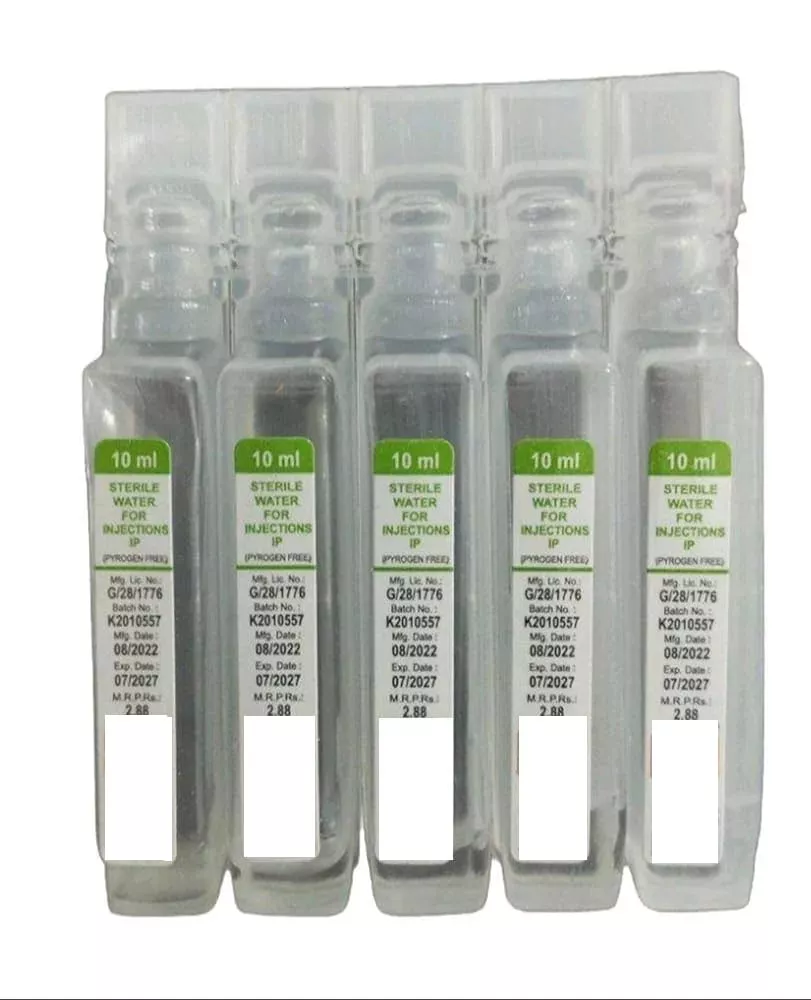
Sterile Water for Injection is a sterile, nonpyrogenic preparation of water intended for the reconstitution or dilution of compatible injectable medicines. It contains no added antimicrobial preservatives or bacteriostatic agents. The manufacturer, packaging, and intended use should be confirmed from the original product label.
What Is Sterile Water for Injection?
Sterile Water for Injection (SWFI) is a pharmaceutical-grade preparation used to dissolve, reconstitute, or dilute certain injectable medicines before administration.
Many injectable medications are supplied as powders or concentrated solutions that require preparation before use.
Sterile Water for Injection provides a sterile diluent for compatible medicines, allowing them to be prepared according to the manufacturer’s instructions.
It is commonly used in hospitals, clinics, pharmacies, and other healthcare settings.
Sterile Water for Injection contains no active therapeutic drug. Its primary function is to serve as a pharmaceutical solvent or diluent.
How Does Sterile Water for Injection Work?
This for Injection functions as a pharmaceutical solvent rather than a medicine with direct pharmacological activity.
1. Dissolves Compatible Medicines
It helps dissolve certain powdered injectable medicines to form solutions suitable for their intended administration route.
2. Supports Medicine Reconstitution
Some injectable medicines are supplied in lyophilized or powdered form to maintain stability.
This for Injection may be used to reconstitute these medicines when specifically recommended by the manufacturer.
3. Dilutes Compatible Injectable Solutions
It may be used to dilute certain injectable medicines to an appropriate concentration, provided the final preparation meets the required compatibility, tonicity, and administration specifications.
4. Provides a Sterile Preparation Medium
This Is for Injection is manufactured to meet pharmaceutical standards for sterility and endotoxin limits.
5. Supports Injectable Medicine Preparation
It is used in healthcare settings where sterile medication preparation is required.
Sterile Water for Injection does not independently treat infections, dehydration, pain, or other medical conditions.
Uses of Sterile Water for Injection
1. Reconstitution of Injectable Antibiotics
Sterile Water for Injection may be used to reconstitute certain powdered antibiotics when specified in their prescribing information.
Examples of injectable antibiotics that may have compatible formulations include:
- Ceftriaxone
- Cefotaxime
- Ceftazidime
- Meropenem
- Other compatible injectable antibiotics
Important: Compatibility, dilution volume, and route of administration vary by medicine and manufacturer. Not every formulation should be reconstituted with sterile water.
2. Preparation of Injectable Medicines
Used for preparing certain injectable medications supplied as dry powders or concentrates.
3. Pharmaceutical Dilution
May be used as a diluent for compatible pharmaceutical preparations when specified by the manufacturer.
4. Hospital and Clinical Medication Preparation
Commonly used by healthcare professionals in sterile medication preparation procedures.
5. Reconstitution of Selected Lyophilized Products
Certain lyophilized pharmaceutical products may require Sterile Water for Injection for reconstitution.
Only the diluent specifically recommended in the product instructions should be used.
How to Use Sterile Water for Injection
Sterile Water for Injection should be handled by qualified healthcare professionals using appropriate aseptic techniques.
Step 1: Verify the Medication
Confirm that the medicine being prepared is compatible with Sterile Water for Injection.
Step 2: Check the Packaging
Inspect the container for damage, leaks, discoloration, particles, or signs of contamination.
Step 3: Follow the Manufacturer’s Instructions
Use the exact diluent volume and preparation method specified for the medicine.
Step 4: Maintain Sterile Conditions
Use appropriate aseptic techniques during preparation.
Step 5: Inspect the Prepared Solution
Check the final solution according to the medicine’s instructions before administration.
Step 6: Administer the Prepared Medicine
The reconstituted or diluted medicine should be administered only by the approved route and according to its prescribing instructions.
Step 7: Dispose of Unused Product
Single-dose containers without preservatives should not be stored for repeated use. Discard unused contents according to the applicable instructions.
Important: Never inject Sterile Water for Injection directly into a vein without appropriate solutes. It may cause hemolysis and serious complications.
Common Side Effects
Sterile Water for Injection does not contain an active therapeutic drug.
When used correctly as a diluent, adverse effects are generally associated with the reconstituted medicine, administration procedure, or preparation technique.
Possible complications include:
- Injection-site discomfort from the prepared medicine.
- Local irritation
- Pain during injection
- Reactions to the administered medication
- Infection associated with improper handling
- Irritation caused by an unsuitable final concentration
The safety profile depends on the medication being prepared and the route of administration.
Serious Side Effects
Improper preparation or administration may result in serious complications, including:
- Hemolysis from direct intravenous administration of hypotonic sterile water
- Severe electrolyte disturbances
- Tissue irritation
- Serious infection from contaminated preparations
- Medication errors caused by incorrect dilution
- Severe reactions to incompatible drug mixtures
Important: Direct intravenous administration of Sterile Water for Injection without appropriate solutes can cause red blood cell destruction and potentially life-threatening complications.
Contraindications & Precautions
Direct Intravenous Administration
Sterile Water for Injection should not be injected intravenously by itself because it is hypotonic.
Medication Compatibility
Only use Sterile Water for Injection when it is identified as a suitable diluent for the specific medication.
Sterility
Do not use a container if its seal is damaged or contamination is suspected.
Single-Dose Containers
Sterile Water for Injection generally contains no antimicrobial preservative. Single-dose containers must not be reused.
Incorrect Dilution
Improper dilution can change the concentration, stability, or safety of the prepared medicine.
Route of Administration
The permitted route depends on the final medication preparation, not on sterile water alone.
Pediatric Patients
Preparation volumes and medicine concentrations require particular care in infants and children.
Pregnancy and Breastfeeding
The safety of a reconstituted medicine depends on the medication itself and the clinical circumstances.
Storage
Follow the storage conditions printed on the product label.
Advantages
- Sterile pharmaceutical-grade diluent.
- Contains no added antimicrobial preservatives.
- Suitable for reconstitution of compatible injectable medicines.
- Helps dissolve selected powdered medications.
- Supports preparation of injectable solutions.
- Available in multiple container sizes.
- Used in hospitals and clinical settings.
- Manufactured according to pharmaceutical quality standards.
- Contains no corticosteroid or hormone.
- No direct pharmacological activity.
Disadvantages / Limitations
- Cannot be injected intravenously by itself.
- May cause hemolysis if administered directly into the bloodstream.
- Not compatible with every injectable medicine.
- Requires proper aseptic handling.
- Contains no antimicrobial preservative.
- Single-dose containers are not intended for repeated use.
- Incorrect dilution may cause medication errors.
- Does not treat any medical condition independently.
- Not intended for drinking or routine hydration.
- Must not be substituted for bacteriostatic water or normal saline unless specifically permitted.
Important Notes
Sterile Water for Injection is intended for pharmaceutical preparation, not direct therapeutic use.
Sterile Water vs. Normal Saline: Sterile Water for Injection contains water without added sodium chloride. Normal saline contains 0.9% sodium chloride and is approximately isotonic.
Sterile Water vs. Bacteriostatic Water: Sterile Water for Injection does not contain an antimicrobial preservative. Bacteriostatic Water for Injection contains a preservative, commonly benzyl alcohol, and has different usage restrictions.
Single-Dose Use: Many Sterile Water for Injection containers are intended for single use only.
Compatibility: Always check the medicine’s official prescribing information before selecting a diluent.
Do Not Self-Inject: Sterile Water for Injection should not be self-administered as an independent injection.
Storage: Follow the manufacturer’s instructions and protect containers from contamination.
Frequently Asked Questions
What is Sterile Water for Injection used for?
It is used to reconstitute or dilute compatible injectable medicines before administration.
Does Sterile Water for Injection contain any active medicine?
No. It contains sterile pharmaceutical-grade water without an active therapeutic drug.
Can Sterile Water for Injection be injected directly?
It must not be injected intravenously without appropriate solutes because it is hypotonic and can cause hemolysis.
Is Sterile Water for Injection the same as normal saline?
No. Normal saline contains 0.9% sodium chloride, while Sterile Water for Injection does not contain sodium chloride.
Can Sterile Water for Injection be used for antibiotics?
Yes, for certain injectable antibiotics when the manufacturer specifically recommends sterile water as the diluent.
Can Sterile Water for Injection be used for ceftriaxone?
Some ceftriaxone formulations can be reconstituted with Sterile Water for Injection. The exact instructions depend on the product and intended administration route.

Reviews
There are no reviews yet.