
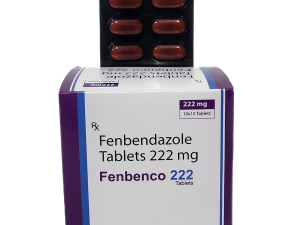
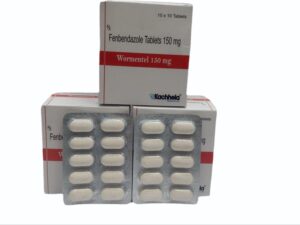
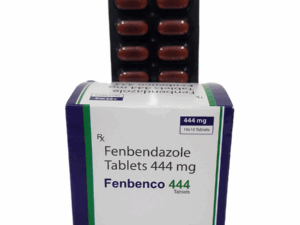









Fenbendazole is primarily a veterinary antiparasitic medicine. A 1000 mg strength does not establish the intended animal species, formulation, or correct dose. Verify the exact product before publishing its listing.
What Is Fenbendazole 1000 mg?
Fenbendazole 1000 mg is a veterinary anthelmintic product containing fenbendazole, a broad-spectrum antiparasitic agent belonging to the benzimidazole class.
Fenbendazole is used in veterinary medicine to treat and control certain parasitic worm infections in animals.
It works by interfering with the parasite’s ability to maintain essential cellular functions, eventually causing susceptible worms to die or be eliminated.
Depending on the formulation, animal species, and regulatory approval, fenbendazole may be used against certain:
- Roundworms
- Hookworms
- Whipworms
- Gastrointestinal nematodes
- Lungworms
- Certain tapeworm species
Not every fenbendazole product is approved for every parasite or animal species.
A 1000 mg product may be intended for particular livestock or other animals, depending on its formulation and labeling.
Fenbendazole is sometimes discussed online for human diseases, including cancer. However, fenbendazole is not an approved human cancer treatment, and reliable clinical evidence has not established that it safely or effectively treats cancer in people.
How Does Fenbendazole Work?
1. Inhibits Parasite Microtubule Formation
Fenbendazole binds to beta-tubulin in susceptible parasites and interferes with microtubule assembly.
2. Disrupts Cellular Functions
Microtubules are important for intracellular transport and other essential cellular processes.
3. Interferes With Nutrient Utilization
Fenbendazole disrupts parasite metabolism, including processes involved in obtaining and using energy.
4. Reduces Parasite Survival
These effects impair the parasite’s ability to survive and reproduce.
5. Supports Parasite Elimination
Susceptible parasites may die and subsequently be eliminated from the animal’s body.
6. Provides Activity Against Selected Worm Species
Fenbendazole has activity against several nematodes and certain other parasites, depending on species and formulation.
7. Supports Veterinary Parasite-Control Programs
It may be used as part of a veterinarian-directed parasite management plan.
Uses of Fenbendazole 1000 mg
1. Gastrointestinal Roundworm Infections
Fenbendazole is used to treat susceptible gastrointestinal roundworm infections in approved animal species.
2. Hookworm Infections
Certain veterinary fenbendazole formulations are indicated for susceptible hookworm infections.
3. Whipworm Infections
Fenbendazole may be effective against certain whipworm species, depending on the animal and approved product.
4. Selected Tapeworm Infections
Some veterinary formulations have activity against specific tapeworm species.
Fenbendazole is not effective against every tapeworm.
5. Lungworm Infections
Certain fenbendazole products are used to treat susceptible lungworm infections in designated animal species.
6. Livestock Parasite Management
Species-specific formulations may be used in livestock parasite-control programs.
7. Companion Animal Deworming
Some fenbendazole products are approved for particular intestinal parasites in dogs or other companion animals.
A 1000 mg product should not automatically be considered appropriate for small animals.
8. Other Veterinarian-Directed Uses
A veterinarian may select fenbendazole for certain additional parasitic infections when supported by appropriate clinical guidance.
Important: These are general uses of fenbendazole as an active ingredient. They are not verified indications for an unidentified 1000 mg product.
How to Administer Fenbendazole 1000 mg
Fenbendazole should be administered according to the instructions for the specific veterinary product.
General Administration Guidelines
- Confirm the intended animal species.
- Verify the product’s active ingredient and formulation.
- Identify the parasite being treated.
- Determine the animal’s accurate body weight.
- Follow the veterinarian’s prescribed regimen.
- Use the appropriate administration method.
- Avoid giving additional doses without veterinary guidance.
- Observe the animal for adverse reactions.
- Follow the complete treatment schedule.
- Arrange follow-up parasite testing when recommended.
Dosage Information
Fenbendazole dosing varies considerably depending on:
- Animal species
- Body weight
- Parasite type
- Infection severity
- Product formulation
- Approved treatment schedule
- Veterinary recommendations
A 1000 mg tablet or bolus is not a universal dose.
The correct dose cannot be determined from the strength alone.
A veterinarian should establish the appropriate dose and duration for the intended animal.
Can Fenbendazole 1000 mg Be Given Daily?
Some veterinary treatment protocols involve consecutive daily administration, while others use different schedules.
The appropriate regimen depends on the product and indication.
Do not administer daily without checking the specific product instructions.
Food Administration
Instructions for administration with food vary by formulation.
Follow the manufacturer label or veterinary advice.
Missed Dose
If a scheduled dose is missed, contact the veterinarian or follow the approved product instructions.
Do not double the next dose without guidance.
How Long Does Fenbendazole Take to Work?
Fenbendazole begins acting against susceptible parasites after administration.
However, treatment success depends on:
- Parasite species
- Animal species
- Severity of infection
- Correct dosage
- Treatment duration
- Parasite susceptibility
- Reinfection risk
A reduction in parasite burden may occur during or after treatment.
Follow-up fecal examinations may be recommended to evaluate treatment effectiveness.
Potential Benefits of Fenbendazole
Broad Anthelmintic Activity
Fenbendazole has established veterinary activity against several susceptible parasitic worm species.
Gastrointestinal Parasite Control
Appropriately selected treatment can reduce the burden of susceptible intestinal worms.
Supports Animal Health
Successful parasite treatment may improve animal health when parasites are contributing to illness.
Veterinary Deworming Programs
Fenbendazole may be incorporated into parasite-control programs under veterinary guidance.
Multiple Veterinary Formulations
Fenbendazole is available in different veterinary dosage forms for different species and applications.
Targeted Treatment
A veterinarian can select fenbendazole when the identified parasite is susceptible.
Possible Side Effects
Fenbendazole is generally tolerated by many animals when used according to species-specific approved labeling.
However, adverse effects may occur.
Possible reactions include:
- Vomiting
- Diarrhea
- Reduced appetite
- Gastrointestinal discomfort
- Hypersensitivity reactions
- Other species-specific adverse reactions
Adverse effects vary by animal species, dose, and formulation.
Contact a veterinarian if unusual symptoms occur.
Serious Adverse Reactions
Seek veterinary attention if the animal develops:
- Severe or persistent vomiting
- Severe diarrhea
- Significant weakness
- Difficulty breathing
- Facial swelling
- Severe allergic reactions
- Neurological abnormalities
- Marked changes in behavior or activity
Excessive dosing or use in an unsuitable species may increase the risk of adverse effects.
Contraindications & Precautions
1. Species-Specific Use
Use only in animal species for which the product is approved or appropriately prescribed.
2. Product Strength
Verify whether the 1000 mg strength refers to a tablet, bolus, sachet, or another dosage unit.
3. Accurate Body Weight
Veterinary antiparasitic dosing often depends on body weight.
4. Allergy to Fenbendazole
Avoid use in animals with known hypersensitivity to fenbendazole or formulation ingredients.
5. Pregnancy
Safety during pregnancy depends on the animal species and specific product.
6. Lactation
Use in lactating animals must follow veterinary guidance and applicable product restrictions.
7. Young Animals
Age restrictions vary by product and species.
8. Liver Disease
Animals with significant liver disease may require additional veterinary assessment.
9. Debilitated Animals
Weak, severely ill, or malnourished animals should be assessed before treatment.
Reviews
There are no reviews yet.